Table of Contents
- What is studying in Germany like for Indian students?
- Why Indian students choose Germany in 2026
- Key benefits of studying in Germany for international students
- Possible challenges for Indian students
- Eligibility requirements for Germany in 2026
- The APS certificate for Indian students
- Admission process for German universities
- Cost of living in Germany 2026
- The Blocked Account (Sperrkonto)
- Scholarships for Indian students to study in Germany
- Visa considerations for Indian students
- Student journey: Arjun’s path to Munich
- Career outcomes after graduation in Germany
- Common mistakes students make while applying to study in Germany
- Checklist before applying for studying in Germany
- Frequently Asked Questions
Key takeaways
- APS certification: A mandatory academic verification for all Indian applicants before university submission.
- Financial requirement: The 2026 Blocked Account amount is set at EUR 11,904 (EUR 992 per month)
- Digital visa workflow: Shift towards the Consular Services Portal (CSP) for streamlined Indian applications
- Post-study rights: Access to an 18-month job-seeker visa upon graduation
What is studying in Germany like for Indian students?
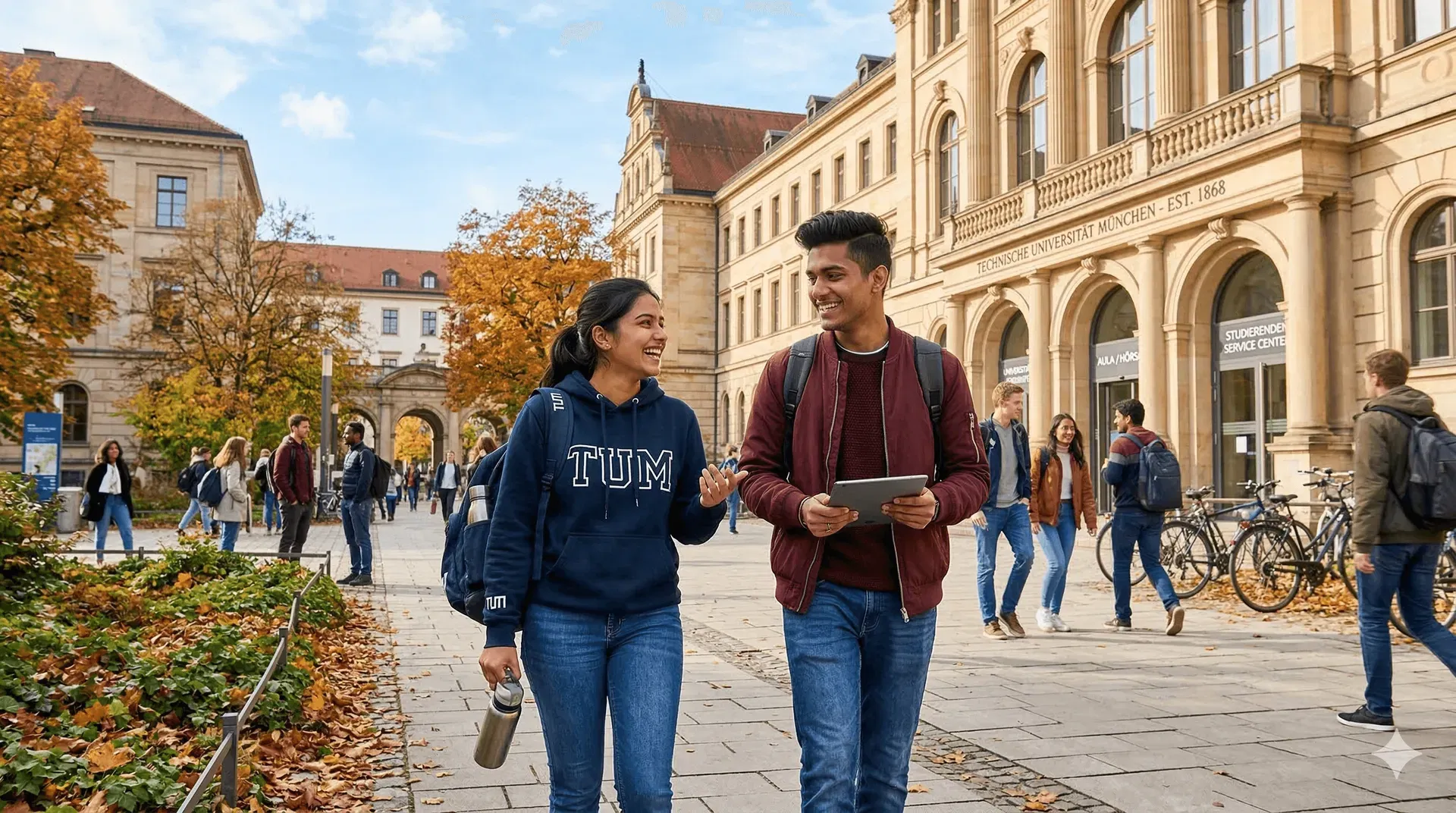
Studying in Germany is a blend of rigorous academic discipline and a high-quality lifestyle. For an Indian student, the transition involves moving from a theory-heavy education system to one that prioritises practical application.
You will find a multicultural environment where over 450,000 international students contribute to a diverse campus life. While English is the medium of instruction for most international programmes, integrating into the local culture through basic German language skills is highly encouraged for social and professional success.
Why Indian students choose Germany in 2026
The primary driver remains the unbeatable value proposition. While traditional destinations like the USA or UK face rising costs, Germany offers:
- Research leadership: Strong emphasis on Industry 4.0, renewable energy, and automotive engineering.
- Economic stability: As Europe's economic engine, Germany provides a secure environment for long-term career planning.
Also read: Intakes in Germany
Key benefits of studying in Germany for international students
- Germany offers the unique advantage of no tuition fees for most public universities, making education highly affordable for international students.
- Students benefit from a high standard of living, with access to excellent public transport, safety, and overall quality of life.
- Extensive travel rights within the Schengen Area allow students to explore many European countries with ease.
- The 2026 job market is particularly hungry for STEM graduates, creating numerous opportunities for skilled workers.
- The recent increase in the statutory minimum wage to EUR 13.90 per hour means that part-time work now provides significant financial relief for those managing their own living expenses.
- Germany is home to world-renowned universities that offer top-tier education in fields such as engineering, computer science, and business.
- The country's institutions are globally recognised for their research, academic excellence, and state-of-the-art facilities.
Ready to secure your spot in a German university for 2026? with Edvoy's expert advisors today.
Possible challenges for Indian students
- The APS hurdle: Verification can be time-consuming; start at least 6 months early
- Bureaucracy: German administrative processes (like Anmeldung) require strict adherence to paperwork
- Language barrier: While you can study in English, daily life and the hidden job market often require B1/B2 German.
Secure your spot in a German university for 2026 with our expert guidance today.
Related articles


Eligibility requirements for Germany in 2026
- To qualify for a German university, Indian students must meet stringent academic and legal criteria. These vary based on your level of study.
- Students must hold a recognised secondary school leaving certificate (Class 12 or equivalent) for undergraduate programmes or a bachelor's degree for postgraduate programmes.
- For undergraduate programmes, applicants should typically have a minimum percentage of 65-75% in their Class 12 exams, depending on the university and course.
- For postgraduate courses, applicants must hold a relevant bachelor’s degree with at least 60-70% marks (depending on the programme and university).
- Proficiency in the German or English language is required, depending on the language of instruction of the programme. For German-taught programs, proof of German proficiency through tests like TestDaF or DSH is necessary, while for English-taught programs, a TOEFL or IELTS score is required.
- Students may also need to submit standardised test scores such as GRE or GMAT for certain programmes (e.g., engineering or business).
- Some programmes might have additional requirements such as a portfolio, work experience, or an interview.
The APS certificate for Indian students
The Akademische Prüfstelle (APS) India is the most critical hurdle. All Indian students with degrees from Indian boards or universities must have their documents verified by the APS before applying for a student visa.
- When to apply: As soon as you have your final transcripts
- Cost: Approximately INR 18,000
- Process: Submit digital scans and physical documents; verification usually takes 4–8 weeks
Admission process for German universities
The 2026 application cycle is predominantly digital. Most Indian students will engage with uni-assist, a service that evaluates international credentials against German standards.
- Uni-Assist registration: Create an account on my.uni-assist.de
- Document upload: Submit your APS certificate (mandatory), transcripts, and language scores
- Processing fee: EUR 75 for the first application; EUR 30 for each thereafter
Cost of living in Germany 2026
While your Blocked Account provides EUR 992 monthly, cities like Munich or Frankfurt may require a tighter budget.
Monthly budget (average):
- Rent: EUR 450 – EUR 700
- Health insurance: EUR 125 – EUR 145 (mandatory)
- Groceries: EUR 200 – EUR 250
The Blocked Account (Sperrkonto)
To secure your visa, you must fund a Blocked Account.
- Total amount: EUR 11,904 for one year
- Monthly payout: EUR 992
- Providers: Expatrio, Fintiba, and ICICI Bank Germany are the primary choices for Indian students
Scholarships for Indian students to study in Germany
While tuition is low, the DAAD (German Academic Exchange Service) offers competitive scholarships for high-achieving postgraduate (PG) and PhD students. These scholarships are highly regarded and provide financial support to students pursuing higher education in Germany.
- The DAAD offers various funding programmes, including the DAAD Scholarship for Master’s students, the DAAD Scholarship for Doctoral students, and the DAAD Research Grant for postgraduate research projects. These scholarships often cover tuition fees, living expenses, travel costs, and health insurance.
- Apart from the DAAD, many universities in Germany offer their own scholarship programmes to international students. One such programme is the Deutschlandstipendium, which offers EUR 300 per month for students who show exceptional academic performance and social commitment. This scholarship is available to both German and international students and is often awarded on a merit-based system.
- Some universities also offer full or partial tuition fee waivers for international students who demonstrate outstanding academic abilities. These are especially common for students pursuing STEM (Science, Technology, Engineering, Mathematics) courses.
- The Konrad Adenauer Stiftung (KAS) provides scholarships for postgraduate students and young professionals from India, aimed at fostering democracy, development, and education. The scholarship includes a monthly stipend and other financial support.
- The Erasmus+ Program is another excellent opportunity for Indian students looking to study in Germany. This EU-funded programme supports international students with grants for exchange programs and joint master’s degrees at participating German universities.
- Additionally, several private and non-governmental organisations offer scholarships to Indian students in Germany. These include the Heinrich Böll Foundation and the Friedrich Ebert Foundation, which support students who exhibit strong academic potential and social engagement.
- For Indian students pursuing specific fields like economics or engineering, there are industry-based scholarships offered by companies or sector-specific organisations such as Siemens or the German Chemical Industry Association (VCI).
- It’s important for students to regularly check the official scholarship portals such as MyStipendium and Stipendienlotse, as well as the individual university websites, for updates on available scholarships.
Secure your spot in a German university for 2026 with our expert guidance.
Visa considerations for Indian students
The German Federal Foreign Office uses the Consular Services Portal (CSP) for digital-first applications.
- Digital Upload: Pre-verify documents on the CSP portal
- VFS appointment: Submit biometrics in person
- Visa fee: EUR 75 (approx. INR 7,000)
Student journey: Arjun’s path to Munich
Arjun is a Mechanical Engineering student from Pune. He wants to study for a Master’s in Germany in 2026.
In August 2025, Arjun takes the IELTS. He scores 7.5. In September, he gathers his college transcripts. He applies for the APS certificate immediately. While waiting for APS, he researches TU9 universities.
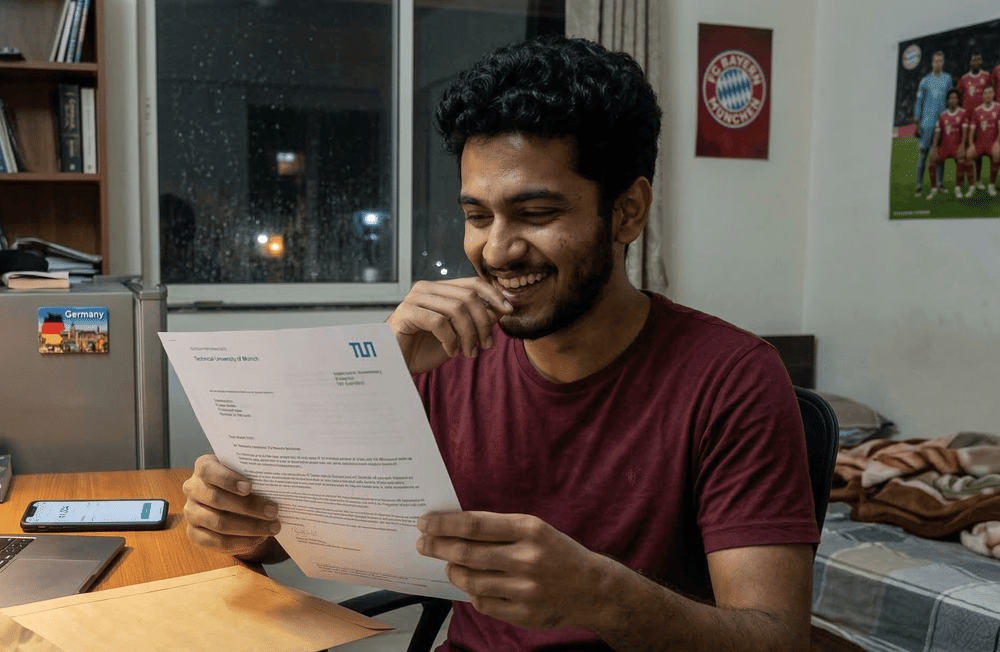
In January 2026, he receives his APS certificate. He uses Uni-assist to apply to three universities. In May 2026, he gets an admission letter from TU Munich. He immediately opens a blocked account with €11,904.
He books his visa appointment in June. His visa arrives in August. Arjun spends August looking for a room in Munich. He moves to Germany in September. He starts his classes in October 2026.
Career outcomes after graduation in Germany
Upon completing your degree in Germany, you are eligible for the 18-month Job-Seeker Visa, which allows you to stay in the country and search for employment related to your field of study. This visa provides ample time to explore job opportunities and gain valuable work experience in one of the most robust job markets in Europe.
- The German job market is highly favourable for international graduates, especially those in STEM fields, business, and engineering. Companies across various industries, including automotive, technology, healthcare, and finance, actively recruit skilled professionals.
- Graduates from German universities are often highly sought after, as German education is known for its rigorous academic standards and emphasis on practical skills. Many employers value the practical training and internships that form a part of the German university experience.
- After finding a suitable job, international graduates can apply for the EU Blue Card in 2026. The EU Blue Card is designed to attract highly skilled workers to the European Union, and it provides numerous benefits, including fast-track permanent residency options. To qualify for an EU Blue Card, you must secure a job offer with a salary exceeding EUR 50,700 per year (or EUR 45,934.20 for STEM graduates).
- The EU Blue Card also gives graduates access to long-term work opportunities within the EU, as well as family reunification options, ensuring a stable and fulfilling career path within the region.
- The 18-month Job-Seeker Visa can also be converted into a work visa once you have secured a job, allowing you to work in Germany for up to four years. After this period, you may apply for permanent residency, making it a long-term career option for those wishing to establish themselves in Germany.
- For those interested in entrepreneurship, Germany offers various support systems for starting a business, including funding options, incubators, and access to a thriving start-up ecosystem in cities like Berlin, Munich, and Hamburg.
- Graduates who wish to work in research or academia can also explore postdoctoral research opportunities, as Germany is home to many renowned research institutions and universities offering cutting-edge research facilities.
Common mistakes students make while applying to study in Germany
- Late APS application: One common mistake is waiting for a university offer before applying for the Academic Proficiency Certificate (APS). This delay can cause students to miss the visa application window. It’s important to apply for APS well in advance of receiving your offer letter, as processing times can take several weeks.
- Ignoring the buffer: Another common oversight is failing to deposit an extra EUR 100 in your Blocked Account to cover unforeseen bank fees. The blocked account is a mandatory requirement for obtaining a student visa in Germany, and the bank often charges processing fees that may not be accounted for in the initial deposit. Always ensure you have a buffer amount to cover these costs, as this could delay your visa process if not properly planned.
- Not understanding the Health Insurance requirement: Students often forget to arrange for health insurance coverage, which is a legal requirement for obtaining a residence permit in Germany. While many students assume that their travel insurance will be sufficient, German authorities typically require proof of valid German health insurance that meets the country's standards.
- Missing deadlines for visa and residence permit applications: Students sometimes underestimate the time required for visa and residence permit processing. It’s essential to track deadlines closely and submit all required documents on time. Missing these deadlines could result in delays in arriving for the start of the semester or even visa rejections.
- Underestimating the cost of living: Many students focus too much on tuition fees and overlook other living expenses such as housing, food, transportation, and study materials. It’s important to budget realistically, taking into account the cost of living in the city where you plan to study.
- Lack of language preparation: While many courses are offered in English, students often overlook the importance of learning German for daily life. Basic proficiency in German can be crucial for securing internships, part-time jobs, and even for general day-to-day interactions.
- Not researching the job market: Students often fail to research the job market in Germany before arriving. Understanding the industries that are hiring, the salary expectations, and how to leverage the career services at your university can significantly impact your post-graduation opportunities.
- Overlooking networking opportunities: Networking is crucial in Germany, particularly in industries like engineering, technology, and business. Many students make the mistake of not attending career fairs, industry events, or university-hosted networking sessions that could help them make valuable connections.
- Underestimating the bureaucracy: Germany is known for its strict and detailed administrative processes. Students sometimes fail to understand the bureaucratic requirements for registering with the local authorities, extending their visa, or enrolling in courses. Be sure to familiarise yourself with these processes early to avoid complications later.
Ready to secure your spot in a German university for 2026? with Edvoy's expert advisors today.
Checklist before applying for studying in Germany
- APS certificate: Obtained from APS India
- Language proficiency: IELTS/TestDaF scores ready
- Blocked Account: Funded with EUR 11,904
- Digital documents: High-quality PDF scans for the CSP
Frequently Asked Questions
How long does the APS certificate take for Indian students in 2026?
Expect a wait time of 4 to 8 weeks. Apply as soon as you have your final semester transcripts.
What is the minimum wage for student jobs in Germany in 2026?
The statutory minimum wage is EUR 13.90 per hour as of January 2026.
Can I study in Germany with a low GPA?
Yes, but you should focus on private universities or Fachhochschulen, which often have more flexible admission criteria.
Is the German student visa rejection rate high for Indians?
No. Provided you have a valid APS certificate and a fully funded Blocked Account, the success rate is approx. 90–95%.
Can I take my spouse with me on a student visa?
Yes, via the Family Reunion Visa, though you must prove additional financial means (approx. EUR 11,000+ extra).
Studying in Germany in 2026 is a journey of precision. By securing your APS early, funding your Blocked Account to the updated 2026 standards, and utilising the new digital visa portal, you position yourself for success in Europe’s most stable economy.
Secure your spot in a German university for 2026 with our expert guidance today.