
Start your global education journey with Edvoy’s personalised counselling and application guidance.
If you’re joining an Anna university–affiliated engineering college from the 2025 batch, the Anna University 2025 regulation (R2025) will define how you study, how you’re assessed, and how your degree is evaluated in India and abroad.
Key takeaways
- Anna University 2025 regulation (R2025) applies to students admitted from the 2025 batch onwards.
- It focuses more on continuous assessment, projects, and practical learning, not just the end-of-semester exams.
- The clear credit and GPA system makes it easier for universities abroad to understand your academic profile.
- Structured internships and outcome-based learning help strengthen your CV and SOP.
In this guide, we’ll have a look at what R2025 actually means, what has changed from the previous regulations, and how it affects your future plans for higher studies. Keep reading.
Table of Contents
- What is the Anna University 2025 regulation?
- Key changes in Anna University R2025
- Credit system and grading under R2025
- Grading system of R2025
- Anna University Regulation 2025 (UG/PG) Syllabus in PDF
- How does R2025 affect higher studies and studying abroad?
- Frequently asked questions
What is the Anna University 2025 regulation?
The Anna University 2025 regulation, commonly called R2025, is the latest academic framework for undergraduate and postgraduate engineering programmes at colleges affiliated to Anna University.
Basically, it lays down rules for the curriculum structure, credit system, exams, internal assessments, grading, GPA calculations, and finally, the degree completion.
It’s effective from the 2025 admitted batch onwards. It does not apply to students admitted under R2017 or R2021 unless Anna University officially announces so.
Key changes in Anna University R2025
- R2025 continues the Choice-Based Credit System (CBCS), giving a clearer structure to core subjects, electives, internships, and projects. These credits now clearly reflect actual workload and learning outcomes, which helps you when applying for higher studies abroad.
- R2025 gives more weightage for continuous internal assessment. So, instead of relying heavily on the end-of-semester exams, R2025 focuses more on internal tests, assignments, projects, and practical exam evaluations.
- It also has a clearer focus on programme outcomes. This means that each course is mapped to programme outcomes and learning outcomes.
- It also gives you a better integration of internships and projects, so practical exposure is encouraged earlier in the programme.
For detailed information on the courses offered and their respective credits under the new 2025 curriculum, view the complete course and credit details at Anna University’s official list of undergraduate programme structures.
This resource helps you understand how many credits each theory, lab, project, and elective carries under R2025, and how your overall academic workload is planned across semesters.
Turn your R2025 credits and GPA into global opportunities with Edvoy’s personalised guidance.
Credit system and grading under R2025
While exact credit numbers vary by programme, the core structure remains semester-based, with credits assigned for theory courses, laboratories, projects, and internships. Usually, the grades are given using a letter grade system, which is then converted into SGPA and CGPA.
How SGPA, CGPA, and percentage are calculated under Anna University R2025
Under the Anna University 2025 regulation (R2025), student performance is measured using SGPA, CGPA, and percentage, based on the Choice-Based Credit System (CBCS). Here’s how each is calculated.
SGPA (Semester Grade Point Average)
SGPA reflects your academic performance in a single semester. It is calculated as the weighted average of grade points earned in all courses registered during that semester.
Formula:
SGPA = ∑ (𝐶𝑖 × 𝐺𝑃i) / ∑ 𝐶𝑖
Where:
𝐶𝑖 = Credits assigned to a course
𝐺𝑃i = Grade points obtained for that course
n = Number of courses successfully cleared in the semester
CGPA (Cumulative Grade Point Average)
CGPA represents your overall academic performance across all completed semesters. Anna University calculates CGPA by considering the total credits and grade points earned throughout the programme.
Formula:
CGPA = ∑ (𝐶𝑖 × 𝐺𝑃i) / ∑ 𝐶𝑖
In simple terms, CGPA is the ratio of the total weighted grade points to the total credits earned across all semesters.
Percentage calculation
To calculate the percentage of marks, divide the marks obtained by the total maximum marks and multiply by 100.
Formula:
Percentage = (Obtained marks / Total marks) × 100
Example:
If you score 80 out of 100, your percentage is: (80 ÷ 100) × 100 = 80%
This format is easily understood by international universities, especially in the UK, Europe, Australia, and Canada.
To quickly check your GPA or convert your CGPA to a percentage, you can use these tools:
- Anna University GPA calculator (R2021)
- Anna University CGPA to percentage calculator (R2021)
- How to calculate the percentage of marks: Percentage calculator (R2021)
Grading system of R2025
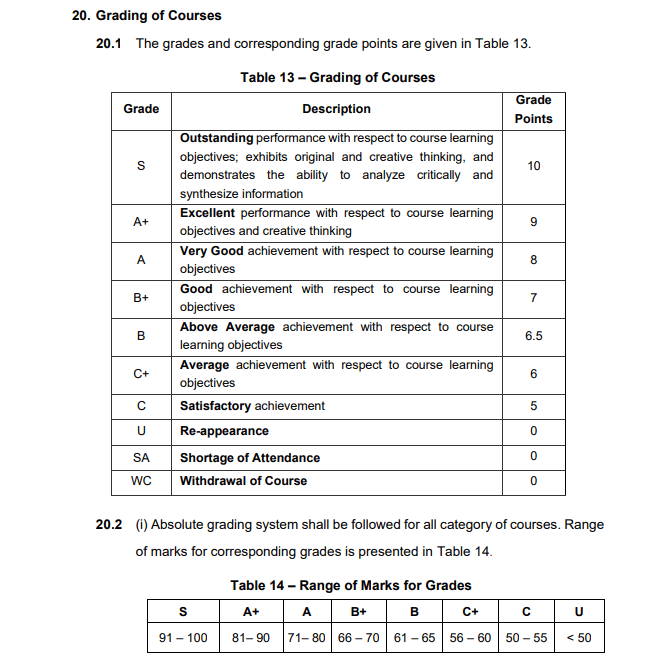
Source: Anna University
Related: Anna University transcript: Guide for Indian students
Related articles


Anna University Regulation 2025 (UG/PG) Syllabus in PDF
B.E. / B.Tech. / B.Arch. / B.Des. - Curriculam & Syllabus - I st Year Students (2025-2026 Batch) R 2025
| UG Degrees | New Syllabus |
|---|---|
| B.E. Computer Science and Engineering | Download |
| B.Tech. Information Technology | Download |
| B.E. Electronics and Communication Engineering | Download |
| B.E. Electrical and Electronics Engineering | Download |
| B.Tech. Artificial Intelligence and Data Science | Download |
| B.E. Computer Science and Engineering (AI and ML) | Download |
| B.E. CSE (Data Science) | Download |
| B.E. CSE (Cyber Security) | Download |
| B.E. Mechanical Engineering | Download |
| B.E. Civil Engineering | Download |
| Other Degrees | Download |
M.E. / M.Tech. / M.Arch. / M.B.A. - Curriculam & Syllabus for 1st Year Students (2025 - 2026 Batch) - R 2025
| PG Degree | Syllabus |
|---|---|
| All Regulations | Download |
How does R2025 affect higher studies and studying abroad?
Now, let’s see how these help you with planning your higher studies and studying abroad.
If you’re planning to study abroad, R2025 is actually helpful. The credit system is clearer, so foreign universities can easily understand what you’ve studied. Since learning is more practical and outcome-based, your marksheets show real learning, not just exam scores.
The way internships and projects are structured also helps you write a strong SOP and CV. Plus, the GPA system used in R2025 matches what most international universities already follow.
Where can I find the official R2025 regulation PDF?
Always refer to Anna University's official 2025 regulation PDF and regulation notifications. Don’t rely on random PDFs online, because the official site will have the correct and latest version.
The Anna University 2025 regulation (R2025) is designed to make engineering education more practical and student-friendly. If you’re joining from the 2025 batch, understanding this regulation early will help you study smarter and make better academic decisions.
And if you’re thinking beyond this, you can get personalised guidance on shortlisting universities, applications, guidance about visas, and more. Edvoy is here to help.
Talk to our experts today and start your study-abroad journey right away!
Frequently asked questions
Is R2025 better than R2021?
R2025 improves on R2021 by focusing more on outcomes, continuous assessment, and real-world skills.
Is the attendance policy changing under R2025?
Anna University has not removed attendance requirements under R2025. Most affiliated colleges are expected to continue enforcing minimum attendance norms as defined by the university and the institution.
Are electives more flexible under R2025?
Yes. R2025 provides clearer elective structures, allowing students to choose subjects aligned with their career interests, higher studies goals, or industry skills, depending on college offerings.
Will internal marks carry more importance in R2025?
Yes. Internal assessments such as tests, assignments, labs, and projects play a more significant role in final grading compared to older regulations.
Are the rules for arrears different under R2025?
R2025 clarifies academic progression rules, but arrear clearance policies generally remain similar unless officially revised by Anna University.