The new international student mindset: From aspiration-led to ROI-led decision making
Summarise or discuss this with AI
International students are increasingly making decisions based on measurable return on investment rather than university prestige. As of April 2026, total degree cost, post-graduation salary, and post-study work visa duration dictate this calculation. STEM graduates globally earn a median USD 98,000 versus USD 69,000 for humanities majors. Germany, Canada, and Australia currently offer the strongest ROI.
Key takeaways
- Career advancement is the primary motivation for international students, cited by 84% in 2024 surveys.
- Total ROI depends on the combination of total education cost, post-graduation salary, and post-study work rights.
- STEM degrees consistently deliver higher financial ROI than humanities degrees.
- Germany offers the highest pure financial ROI due to zero or near-zero tuition at public universities.
- Post-study work visa availability is a critical variable in any ROI calculation.
Table of Contents
- What is the new ROI-led student mindset?
- How to calculate your study abroad ROI
- Which countries offer the best ROI for international students?
- Does field of study change your ROI calculation?
- What is the intangible ROI that employers actually value?
- How do 2026 visa policy changes affect your ROI?
- How can you maximise your ROI before and during your studies?
- Frequently Asked Questions
- How to measure the ROI of your education as an international student?
- What are the key factors to consider to evaluate the ROI of studying abroad?
- Which countries have the best ROI for international students?
- Is studying abroad worth the investment for international students?
- How do 2026 visa policy changes affect my ROI calculation?
- What percentage of international students get jobs after graduation?
- What is the career services satisfaction gap and why does it matter?
- What is the new international student mindset?
- Which degree has the highest ROI for international students?
- Is it worth taking a loan to study abroad?
What is the new ROI-led student mindset?
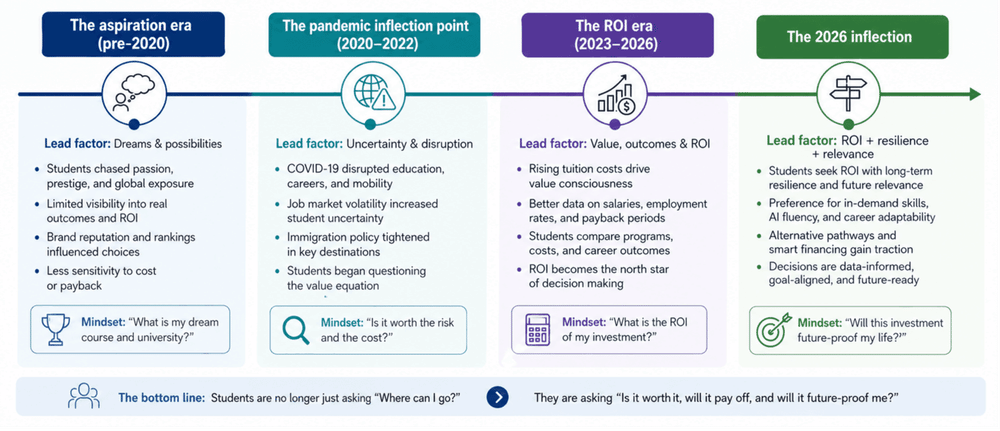
From dreamer to pragmatist: what changed?
The shift from aspiration-led to ROI-led decision making did not happen overnight. It accelerated through rising tuition costs, tightening immigration policies, and better employment outcome data.
The aspiration era (pre-2020) — Students chose universities primarily for brand prestige and the experience of living abroad. Career outcomes were secondary (NAFSA IE Magazine, 2022).
The pandemic inflection point (2020–2022) — COVID-19 disrupted in-person study and exposed the cost-to-value gap. It forced students to ask whether the investment was justified (ICEF Monitor, 2022).
The ROI era (2023–2026) — 84% of international students cite career advancement as their top motivation for studying abroad (Intead/Studyportals, 2024).
The 2026 inflection — Policy uncertainty is making students recalculate before they apply. New US international student enrolments fell 17% in Autumn 2025. This was the first decline after four years of post-pandemic growth (AACRAO, 2025).
Social media and online forums now democratise outcome data. Students can see real salary figures from alumni before applying. Aspiration still matters, but it now operates within strict financial constraints.
What the data says about the mindset shift
Data proves that students are voting with their applications. The 2025 International Student Barometer surveyed 93,843 students from 135 universities. In this study, 85% reported good value for money. However, career services satisfaction stood at just 59% (Etio/ISB, 2025).
This highlights a clear gap between perceived value and career reality. Students react quickly to these realities. The UK experienced a 31% drop in student visa applications in early 2026 (ICEF Monitor, 2026). You must understand these trends to make a smart choice. Knowing this history helps you approach your own ROI calculation with a clear head.
What this means for you:
Apply this ROI framework to your own decision before paying any application fees.
How to calculate your study abroad ROI
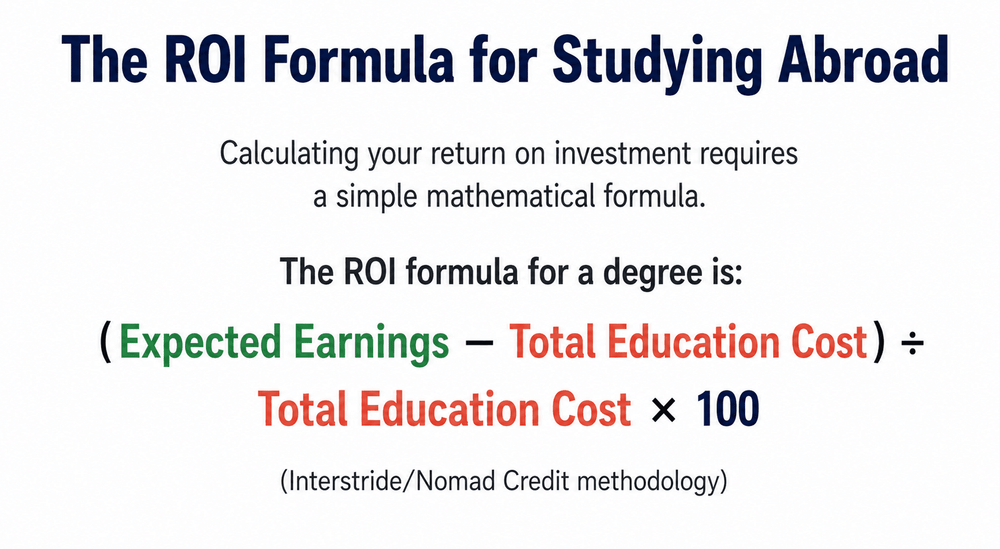
The ROI formula explained
Calculating your return on investment requires a simple mathematical formula.
The ROI formula for a degree is: (Expected Earnings − Total Education Cost) ÷ Total Education Cost × 100 (Interstride/Nomad Credit methodology).
This equation compares your total spending against your future financial gains. Always use median expected earnings to avoid outlier distortion.
What counts as total education cost?
Your total education cost includes much more than just tuition.
- Step 1 — Calculate your total education cost — Add tuition fees, living expenses, visa fees, health insurance, and opportunity cost. You have a single total investment figure (Interstride; Nomad Credit, 2025).
Living expenses include accommodation, food, and transport. Visa application fees add up quickly. For example, the UK Student visa costs GBP 558 as of April 2026. The Australia subclass 500 costs AUD 710. Health insurance, like the UK NHS surcharge at GBP 776 per year, is also mandatory. Check official sources, as these fees are subject to change.
How to estimate your post-graduation earnings
Finding accurate salary data is crucial for a realistic calculation.
- Step 2 — Research post-graduation salaries for your field and destination — Use official labour market data to find median starting salaries. You have a realistic annual earnings figure, not a best-case scenario (Georgetown University; BLS, 2025).
US international graduates who secure employment earn an average USD 80,785. This compares to USD 63,721 for domestic graduates. This is largely due to STEM concentration (Interstride, 2025). Never rely on university marketing materials for salary expectations.
Calculating your break-even point
The break-even point shows when your investment pays for itself.
- Step 3 — Apply the ROI formula — Run the numbers to see your percentage return (Interstride/Nomad Credit, 2025).
- Step 4 — Calculate your break-even point — Divide total education cost by your annual post-graduation salary premium. The premium is the salary above what you would earn without the degree (Interstride, 2025).
- Step 5 — Adjust for post-study work visa duration — Check how long your post-study work visa lasts in your chosen destination. A shorter visa window compresses your break-even timeline (UKVI 2026; IRCC 2025; Home Affairs Australia 2026).
A break-even under five years is strong. A timeline over 10 years warrants serious scrutiny. If you are a STEM student, you face a higher salary ceiling but potentially higher tuition. If you are a business applicant, remember to include the opportunity cost of two years out of the workforce. Once you understand the math, you can compare how different countries stack up.
What this means for you: Run this calculation for your top three university choices before paying any application fees.
Which countries offer the best ROI for international students?
Germany: the value ROI leader
Germany's public universities in 15 of 16 federal states charge zero tuition to international students in 2026. They require only a semester contribution of EUR 150 to EUR 400 (Amber Student, 2026). This makes studying highly affordable. The 18-month Job Seeker Visa offers unlimited work rights.
Germany's EU Blue Card requires a minimum annual salary of EUR 50,700. This enables permanent residency in as little as 21 months with B1 German proficiency (EEC Global, 2026). This is a fast pathway. You will need a blocked account with EUR 1,091 per month to cover living costs.
⚠️ Policy update: EU Blue Card salary thresholds are reviewed annually - expected update Q1 2027 (EEC Global, 2026).
USA: highest absolute salary, longest payback
The USA offers the highest absolute graduate salaries, ranging from USD 65,000 to USD 120,000 for STEM graduates. Students get 36 months of total work authorisation through STEM OPT. However, the new wage-based H-1B lottery reduces entry-level odds.
Only 44.6% of international graduates in the USA secure employment post-graduation, compared with 62.1% of domestic students (Extern.com, 2026). The combination of high tuition and H-1B uncertainty makes the USA a high-risk destination.
Also read: How long does it take to recover study abroad costs for international students?
Canada: balanced ROI with PGWP changes
Canada offers a Post-Graduation Work Permit for up to three years for master's graduates. Master's and PhD students are exempt from the study permit cap from January 2026. Canada's PGWP now requires CLB 7 English proficiency for university degree graduates, per IRCC (2025).
The Express Entry pathway typically takes two to three years.
⚠️ Policy update: IRCC is reviewing PGWP-eligible fields of study for non-degree graduates in early 2026 - some programmes may lose eligibility (IRCC, 2026).
Australia: strong salaries, rising costs
Australia offers strong graduate salaries, but upfront costs are rising. Australia's Temporary Graduate Visa (Subclass 485) fee doubled to AUD 4,600 effective March 2026, per AECC Global. The age limit has also dropped to 35.
High housing costs in cities like Sydney reduce your net savings. These changes materially increase the cost and reduce the window for job searching.
UK: 18-month visa reduction changes the calculation
The UK's Skilled Worker visa requires a minimum annual salary of GBP 41,700 as of July 2025, according to UKVI. Many entry-level roles fall below this threshold. The Graduate Route currently offers two years of work rights.
⚠️ Policy update: The Graduate Route duration is reducing to 18 months for Bachelor's and Master's students from January 2027 (UKVI, 2026).
New Zealand: emerging option with late-2026 visa expansion
New Zealand will introduce a new Short Term Graduate Work Visa in late 2026. This offers six months of open work rights, per Immigration New Zealand. This creates new opportunities. You need NZD 5,000 in support funds to apply.
The job market is smaller, so your ROI depends heavily on your field of study.
| Country | Average tuition (international) | Average graduate salary | Post-study work visa duration | PR pathway timeline | 2026 key change | Value ROI rating |
|---|---|---|---|---|---|---|
| Germany | EUR 0 (public) + EUR 150-400 fee | EUR 44,000-70,000 | 18-month Job Seeker Visa | 21 months | EU Blue Card salary floor EUR 50,700 | ★★★★★ |
| Canada | CAD 20,000-40,000/year | CAD 50,000-85,000 | PGWP up to 3 years | 2-3 years | CLB 7 language test mandatory for PGWP | ★★★★☆ |
| USA | USD 25,000-55,000/year | USD 65,000-120,000 | OPT 12 months + STEM OPT 24 months | 5-10+ years | New wage-based H-1B lottery | ★★★☆☆ |
| Australia | AUD 30,000-50,000/year | AUD 55,000-90,000 | Subclass 485: 2-4 years | 3-5 years | Subclass 485 fee doubled to AUD 4,600 | ★★★☆☆ |
| UK | GBP 15,000-30,000/year | GBP 30,000-55,000 | Graduate Route: 2 years | 5+ years | Skilled Worker salary threshold GBP 41,700 | ★★★☆☆ |
| New Zealand | NZD 25,000-40,000/year | NZD 55,000-80,000 | Post Study Work Visa up to 3 years | 3-5 years | New 6-month Short Term Graduate Work Visa | ★★★☆☆ |
(Check official source - subject to change)
If you are a STEM postgraduate: prioritise Germany for zero tuition or the USA for high salaries. If you are an MBA applicant: prioritise Canada or the UK for better business pathways.
What this means for you: Shortlist two countries from this table and evaluate which specific degree fields perform best there.
Does field of study change your ROI calculation?
STEM vs humanities vs business: the salary gap
Your field of study dramatically impacts your starting salary and visa options. STEM graduates earn a median USD 98,000 versus USD 69,000 for humanities majors (Georgetown University, October 2025). This 42% salary gap is massive at career entry. However, the gap often narrows by mid-career as humanities majors reach higher brackets.
For loan-funded students, the break-even timeline is the critical variable. If you study STEM, prioritise destinations with specific visa extensions. If you study humanities, intangible benefits become proportionally more important.
| Field | Median starting salary | 10-year salary trajectory | Post-study visa alignment | Employer demand |
|---|---|---|---|---|
| STEM | USD 98,000 | Strong upward | Best (STEM OPT, PGWP) | Very high globally |
| Business / Management | USD 75,000–85,000 | Strong for top MBA | Moderate | High |
| Social Sciences / Law | USD 55,000–70,000 | Moderate | Moderate | Moderate |
| Humanities / Arts | USD 45,000–69,000 | Slower start, gap narrows | Lower | Moderate |
Note: Salary data is median for the USA; figures vary by destination country. Use BLS (USA), ONS (UK), or Statistics Canada for destination-specific data.
While financial metrics matter most, employers also look for skills that spreadsheets cannot capture. If you want to align your degree choice with high-demand career paths, start planning your journey with Edvoy.
Related articles


What is the intangible ROI that employers actually value?
What employers say about international graduates
Intangible ROI is harder to measure, but employers actively look for it.
94% of study abroad alumni report building essential job skills; 50% credit international experience with helping them secure their first role (Forum on Education Abroad/Lightcast, 2025).
Multinational companies actively seek cross-cultural competency as a core hiring criterion. According to Talent Culture (2025), 88% of executives say a growth mindset is critical for success.
- Adaptability — This is a top-ranked skill by multinational employers. Alumni demonstrate it through handling unfamiliar systems (IES Abroad, 2025).
- Cross-cultural communication — This skill is critical for roles in multinational teams. International graduates are often preferred for client-facing roles (Forum on Education Abroad/Lightcast, 2025).
- Communication and interpersonal skills — You develop these by managing academic environments in a second culture. This builds immense confidence (IES Abroad, 2025).
- Leadership acceleration — Study abroad alumni enter leadership roles faster than domestic peers. This is a unique career accelerant (Forum on Education Abroad/Lightcast, 2025).
- Global professional network — Alumni networks provide access to employers not available in your home country. Your network matters immensely (Forum on Education Abroad/Lightcast, 2025).
These soft skills are vital, but they cannot protect you from sudden immigration rule changes.
How do 2026 visa policy changes affect your ROI?
Visa policies change frequently. All figures below are correct as of April 2026. Always verify with the official government source before making any decision.
UK: the Graduate Route reduction
The UK's Graduate Route post-study work visa is being reduced from 24 months to 18 months for Bachelor's and Master's graduates, effective January 2027 (UKVI, 2026). This cuts your earnings window. The Skilled Worker visa salary threshold also increased to GBP 41,700 per year. This creates a visa cliff risk for students planning to stay long-term.
Canada: PGWP labour market alignment
Canada now ties PGWP eligibility to specific National Occupation Classification codes. These include Health, STEM, Education, and Skilled Trades (IRCC, 2025). Students in non-priority fields may not qualify for a PGWP at all. Study permit caps have also reduced overall intake, so apply early.
Australia: rising costs and occupation lists
Australia remains a top destination, but upfront costs are climbing. The subclass 485 visa fee doubled to AUD 4,600 in March 2026 (IDP, 2026). Post-study work rights remain generous, offering two to four years. However, occupation list alignment means not all fields get the same visa duration.
USA: OPT and H-1B uncertainty
The US market offers high rewards alongside significant visa risks. The new wage-based H-1B lottery reduces entry-level selection rates to roughly 15%. OPT provides 12 to 36 months of work, but faces ongoing policy scrutiny. Research employer sponsorship rates before choosing a US university.
Understanding these rules is essential, but you also need practical strategies to boost your employability.
What this means for you: Check the official visa page for your chosen country before accepting any university offer.
How can you maximise your ROI before and during your studies?
Your ROI depends heavily on your own proactive strategy.
Only 3% of employed international graduates found their job through university career services (QS/Universities UK International, 2024).
- Choose your programme based on employment outcomes data, not rankings — Look up graduate employment rates for your specific programme. You select a programme with a proven track record (HESA; NACE, 2025).
- Apply for scholarships before taking an education loan — Scholarships reduce total education cost and directly improve ROI. Every bit of funding reduces your break-even point by months (Chevening; Fulbright, 2026).
- Secure an internship or co-op placement during your studies — Programmes with mandatory work placements deliver measurably better employment outcomes. Work experience is the strongest predictor of post-graduation employment (Future Skills Centre Canada, 2025).
- Build your network before you arrive — Connect with alumni from your target programme on LinkedIn before you apply. Your network is your most reliable job search tool (QS/Universities UK International, 2024).
- Research your target employer's visa sponsorship record — Check official registers for H-1B sponsorship rates or LMIA-exempt lists. You avoid investing in a degree where employers do not sponsor graduates (USCIS; UK Home Office, 2026).
- Consider the total cost of living, not just tuition — London and New York have living costs far higher than regional cities. Choosing a lower-cost city can save you thousands (Numbeo, 2026).
Taking these steps early ensures you are not relying solely on your degree certificate to secure a job. If you want to build a strategy that maximises your career outcomes, connect with the experts at Edvoy.
Frequently Asked Questions
How to measure the ROI of your education as an international student?
Many students find this calculation overwhelming, but it is just basic math. Divide your total education cost by your expected annual salary premium (BLS; ONS, 2026). Calculate this break-even point before applying.
What are the key factors to consider to evaluate the ROI of studying abroad?
It is normal to worry about missing hidden costs. The main factors are tuition, living expenses, post-graduation salary, and visa duration (ISB, 2025). Always factor in the opportunity cost of lost income.
Which countries have the best ROI for international students?
Choosing a destination is stressful when rules keep changing. Germany offers the best pure financial ROI due to zero tuition, while the US offers the highest salary ceiling (Georgetown University, 2025). Check current visa rules before deciding.
Is studying abroad worth the investment for international students?
This is the biggest question every applicant faces. Yes, provided you choose a high-demand field and secure post-study work experience (Forum on Education Abroad/Lightcast, 2025). Focus on building your professional network early.
How do 2026 visa policy changes affect my ROI calculation?
Visa uncertainty causes a lot of anxiety right now. Shorter work visas, like the UK's reduction to 18 months, directly compress your earnings recovery window (UKVI; IDP; IRCC, 2026). Verify all visa lengths on official government websites.
What percentage of international students get jobs after graduation?
Employment fears are completely valid in today's competitive market. In the US, only 44.6% of international graduates secure employment post-graduation, compared to 62.1% of domestic peers (Extern, 2026). Prioritise programmes that include mandatory internships.
What is the career services satisfaction gap and why does it matter?
Students often expect universities to hand them a job. 85% of international students feel they receive good value for their study abroad investment (ISB 2025), but career services satisfaction sits at just 59%. This gap is revealing. You must drive your own job search (QS/Universities UK International, 2024).
What is the new international student mindset?
This shift worries many traditional institutions, but it makes sense for students. The new international student mindset is ROI-led rather than aspiration-led. Students prioritise post-graduation job opportunities and payback periods over university brand (A2 Fairs, 2024). Check graduate employment rates before applying.
Which degree has the highest ROI for international students?
Choosing a major is a high-pressure decision. Engineering delivers the highest five-year ROI at 326.6%, followed by Computer Science and IT at 310.3% (Forbes, 2025). Compare these figures against your specific programme's tuition costs.
Is it worth taking a loan to study abroad?
Taking on debt is terrifying for most families. Taking a loan to study abroad may be worth it. Your degree and destination combination must produce a payback period shorter than your post-study visa duration (Rao Consultants, 2024). Run the five-step ROI calculation before signing any loan agreements.
Tags:
Written By

Study Abroad Expert
Reviewed by

Sr Copywriter & Study Abroad Expert
Disclaimer: The views and opinions shared in this site solely belong to the individual authors and do not necessarily represent the