
The international student journey has never been more digital.
Today's students have access to an unprecedented amount of information. University websites, social media, online forums, study abroad platforms, AI tools and student influencers can answer almost any question about studying overseas.
Yet Edvoy's 2026 Student Survey with 850 prospective international students across core markets, reveals an important reality: while students are researching independently more than ever before, trusted guidance remains a critical part of their decision-making.
The findings suggest the future of international recruitment isn't a choice between digital self-service and human support. The institutions that succeed will be those that combine both.
Students begin online, but they don't always finish there
Across all surveyed markets, social media emerged as the leading source of information for prospective international students, accounting for more than 31% of responses. University websites followed closely behind, while online platforms and apps also played a significant role.
This reflects a generation that expects information to be instant, accessible and available across multiple channels. Students increasingly discover destinations, universities and courses through short-form content, creator recommendations and peer experiences long before they engage directly with an institution.
However, digital behaviour varies considerably by region.
Students from the Middle East and North Africa (MENA) were the most social-media-driven audience, with more than 40% relying primarily on social platforms. Africa and Bangladesh also showed strong engagement with digital discovery tools, while students from India and South Asia placed far greater emphasis on university websites and counsellor support.
The implication is clear: students may start their journey online, but there is no single path to making a final decision.
Information doesn't eliminate uncertainty
Perhaps the survey's most important finding is that more information has not reduced uncertainty.
Students are making complex decisions about destinations, tuition fees, scholarships, visa regulations, employability and post-study work opportunities. While digital channels provide information, they don't always provide confidence.
This helps explain why counsellors and recruitment partners continue to play such an influential role. In India, nearly one in five students identified counsellors as a key source of information - almost double the global average - and students across South Asia showed an even stronger reliance on personalised guidance.
Rather than replacing advisors, digital channels appear to be increasing demand for expert support. Students are conducting more independent research, but they still seek reassurance before making life-changing decisions.
Different markets, different priorities
The survey also reinforces the importance of understanding regional differences.
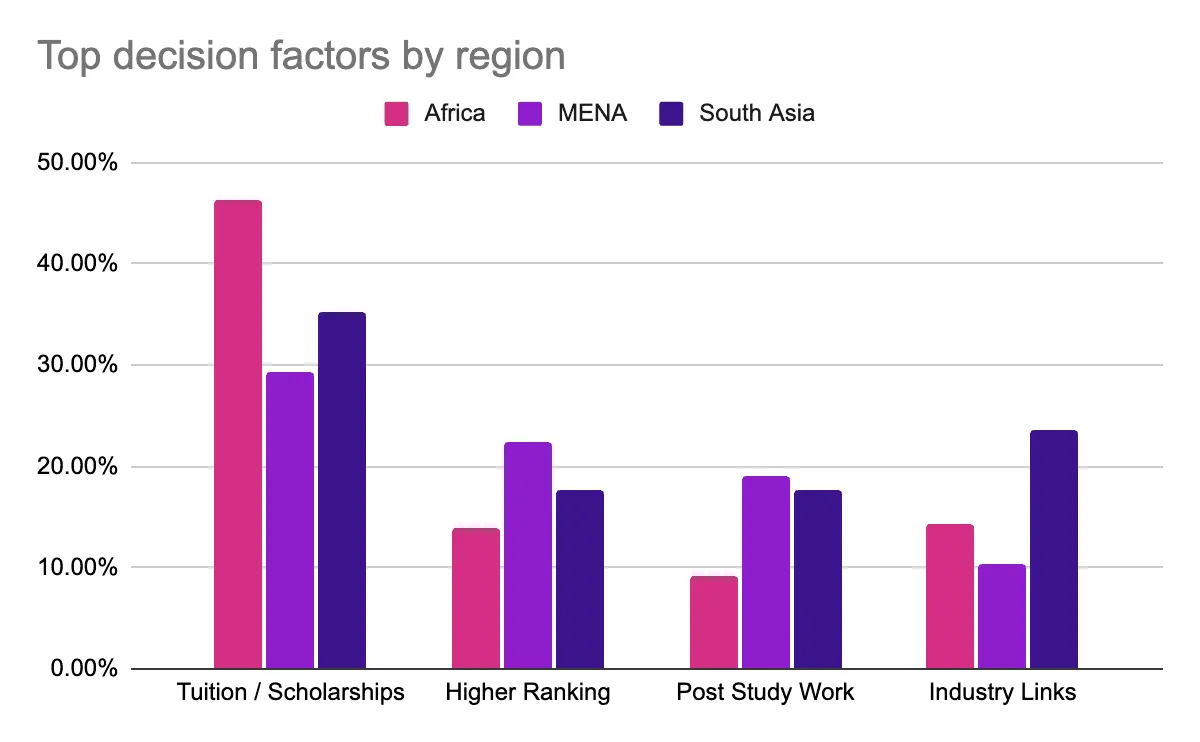
While affordability remains a universal consideration, the factors influencing final decisions vary significantly by market. Students in Bangladesh and Africa prioritise tuition fees and scholarships, while those in India and parts of the Middle East place greater emphasis on university rankings, post-study work opportunities and long-term career outcomes.
Destination preferences are evolving too. The UK remains the most popular study destination overall, while Canada continues to perform strongly across Africa. Italy has gained traction among students from Pakistan and Bangladesh, and Germany continues to attract cost-conscious, career-focused applicants.
These differences highlight the need for recruitment strategies tailored to local market priorities rather than a single global message.
Technology is raising expectations
The survey also points to growing acceptance of AI-powered tools and digital services throughout the student journey.
But technology alone is not enough.
As students become more digitally confident, they also expect faster responses, personalised recommendations and clearer guidance. Increasingly, they don't just want access to information, they want help interpreting it.
This creates an opportunity for institutions and recruitment partners to use technology not as a replacement for human expertise, but as a way to enhance it. The greatest value lies in combining digital efficiency with personalised support.
A changing role for recruitment partners
The findings point to a broader shift in how students engage with the recruitment ecosystem.
Today's applicants are more informed and more independent than previous generations, but they are also navigating greater complexity. As a result, recruitment partners are evolving from application facilitators into trusted advisors.
Their role increasingly includes helping students compare destinations, understand career outcomes, evaluate return on investment, identify scholarships and navigate changing visa policies.
For institutions, this reinforces the value of recruitment partnerships that combine digital reach with expert guidance.
Looking ahead
The future of international recruitment will not be defined by technology, social media or AI alone. It will be shaped by how effectively institutions balance digital engagement with human support.
Students want convenience, speed and information. But they also want reassurance, context and confidence.
The most successful universities and recruitment partners will be those that recognise both needs, and build experiences that bring them together.
For more information please contact Lucy Wigginton, Global Partners Director.


