The USA is among the world’s most popular study destinations, offering world-class academics, global exposure, and a strong economy. The country has a multicultural environment and top-ranked universities that offer you internationally recognised degrees.
In addition, the country's strong economy ensures competitive salaries and opportunities to work in some of the world's top corporations, including Google, Apple, and Microsoft.
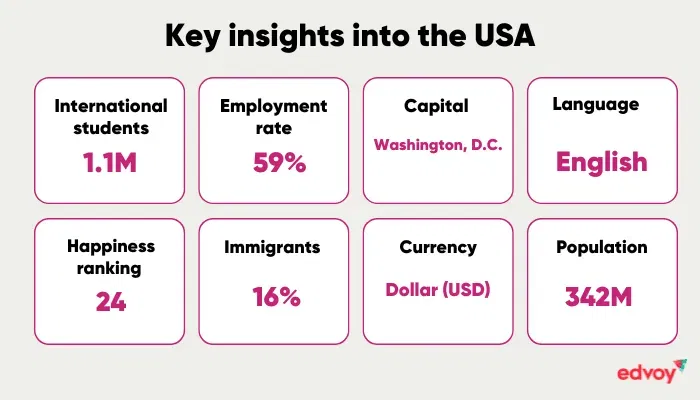
Here are some key insights into the advantages of the USA:
Moving to a new country is a big change in many ways: geographically, culturally, and psychologically. So, if you're concerned about the cost of living in the USA, it’s likely that you'll have concerns about various other aspects of life as well. No worries. Our experts have sorted it out for you in the table below. Click on the topics you’re interested in and get the information you’re looking for.
| Student life in the USA | Best universities in the USA |
| Student visa in the USA | Employment opportunities in the USA |
| Best courses in USA | Education system in the USA |
Studying in the USA can be quite expensive. Apart from tuition fee, you must also consider the cost of living, as this forms a significant portion of your overall expenses. An understanding of the cost of living in the USA, along with a breakdown of expenses for various items, will help you plan your monthly budget realistically.
Living expenses in the USA
Living expenses in the USA vary widely based on your location. However, on average, the cost of living for international students is between USD 10,000 and USD 25,000 annually. If you choose to live in cities like New York and Boston, you should expect higher expenses compared to smaller towns.
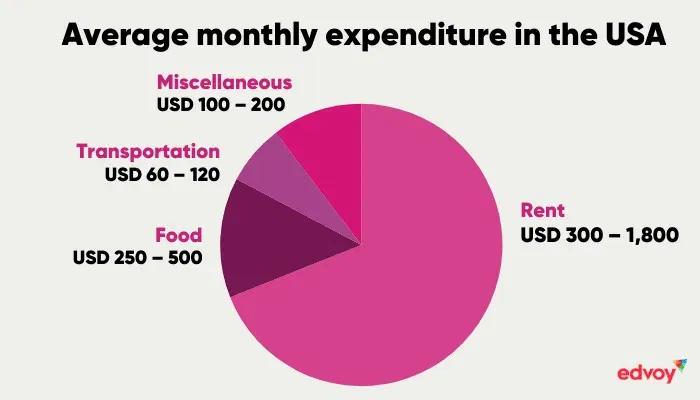
The living expenses primarily include food, transport, and accommodation. There can also be expenses on miscellaneous items such as the internet, additional academic expenses, and entertainment. Your overall expenses on these items may vary based on your lifestyle.
Take a look at the breakdown of living expenses in the USA:
Cost of accommodation for students in the USA
International students have several accommodation choices that are convenient, safe, and affordable. Most universities provide on-campus accommodation that places you close to campus facilities. These are usually residence halls or dormitories, which are often more affordable than the private off-campus accommodation options.
Private off-campus accommodations include shared apartments, homestays, and other private rentals. These accommodations might offer you more independence and a different cultural immersion. The cost will vary based on the city where you choose to live and the type of accommodation rented.
Here are the overall costs you should expect for on-campus and off-campus accommodation:
| Types of accommodation | Details | Monthly expenses |
| On-campus housing | University-provided dormitories or residence halls with utilities, water, electricity, and sometimes food. | USD 800 - USD 1,500 |
| Apartments and shared housing | Off-campus rented apartments or shared flats. Costs vary by city and size. | USD 700 - USD 2,500 |
| Homestays or local host families | Living with a local family; supportive environment. | USD 700 - USD 1,200 |
Tips to reduce accommodation costs
- Start your search early so that you can secure affordable accommodation options. It’s best to start at least 4 to 6 months in advance.
- Consider shared accommodation options and also the possibility of splitting your groceries, internet, and other utility expenses with your roommates.
- Accommodation offered by the university is often cheaper compared to private accommodation.
- Utilise student discounts for internet, groceries, transport, and utilities to reduce overall expenses.
- Renting or buying second-hand furniture will also reduce initial set-up costs.
- Choose accommodations that are away from prime places, like the city centre. However, ensure that the place you choose has good transportation options to save on commuting expenses.
- Ensure that you negotiate with landlords for maximum reduction in the rental. You can ask for additional benefits like a reduction in the deposit or free Wi-Fi.
Dining and grocery costs in the USA
The average cost of groceries per month in the USA ranges between USD 250 and USD 400 per month. You can shop at budget grocery stores like Aldi or local markets or even ethnic grocery stores, where fresh produce and essentials are available with discounts. Farmers’ markets and Community-Supported Agriculture are excellent choices for affordable and fresh produce.
While dining out, it is important to choose affordable restaurants. Mid-range restaurants offer meals that cost between USD 10 and USD 20 per person. There are several other budget-friendly options, such as fast-casual chains and food trucks, where you can find affordable meals that cover everything from American burgers to international cuisines.
Many American universities offer student meal plans, which are affordable and ensure balanced nutrition. Such meal plans can cost between USD 4,000 and USD 7,000 per annum, depending on the number of meals. Most meal plans are flexible with options such as unlimited meals.
Tips to reduce food expenses in the USA
- Create a realistic budget for your food expenses on a monthly basis. This will help you avoid overspending.
- Shop at budget-friendly supermarkets and stores and look for affordable fresh produce.
- Use discount apps and coupons to find good discounts and deals on groceries.
- Since food items in bulk provide good discounts, you can buy non-perishable items like rice or canned beans in large quantities.
- Cook meals as far as possible so that you avoid dining out.
- Use campus options such as student meal plans, as they offer a better value than eating out.
- Limit eating outside to special occasions, and also choose budget-friendly options such as fast-casual spots or food trucks.
- You can reduce beverage costs by avoiding soda and processed drinks.
Transportation costs in the USA
The USA has a diverse range of transportation options. Common ones include subways, buses, streetcars, commuter trains, and trolleys. Major cities like New York provide a wide public transit network and rapid systems such as metros. Bicycles, taxis, and rideshares are also commonly used.
Buses are widely used for commuting and operate in all urban areas, providing you with flexible routes. You can use subways to travel faster and avoid traffic congestion. Since transportation expenses can add up significantly, it’s important to choose cost-effective options. Public transportation is usually cost-effective. Taxis may be convenient for short trips, but they tend to be more expensive. You can also consider using affordable options like bike-sharing programmes to save costs.
Take a look at various transportation options in the USA and their associated costs:
| Mode of transport | Details | Monthly expenses (USD) |
| Public (Buses, Trains, etc.) | Includes city buses, subways, and commuter trains. Offers affordable travel options. | 50 - 130 |
| Cabs | Includes taxis and rideshare services. Convenient for short trips. | 100 - 300 (depends on the usage) |
| Biking | An economical and healthy choice. Many cities have bike lanes and bike-sharing programmes with low monthly fees. | 20 - 50 |
| Walking | Cost-free mode of transport | Free |
Tips to reduce travelling costs
- You can reduce ticket expenses by using monthly cards or public transportation passes.
- For short-distance travels, you can bike to save money.
- Share rides to split expenses.
- Use student discounts wherever possible.
- Use apps to compare the costs of rideshares, taxis, and public transport to choose the most affordable option for your travel.
- Try to combine trips for multiple purposes into one so that you minimise the number of journeys.
- Whenever possible, walk and choose local shopping.
- Using ride shares will reduce the fare price and overall transport costs.
- Avoid using taxis during peak hours when fares are usually high.
- While choosing accommodation, select ones that have easy access to multiple transit options.
Academic expenses in the USA
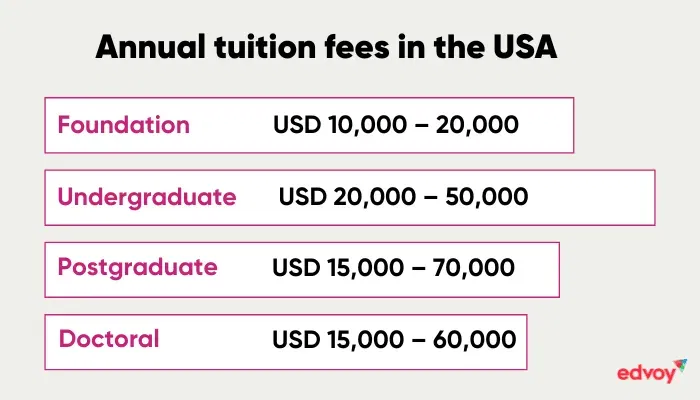
Your academic expenses will vary significantly based on the level of study. For foundation programmes, the cost can range between USD 10,000 and USD 20,000 annually. Undergraduate tuition fees can go up to USD 50,000, and postgraduate programmes can go up to USD 70,000.
In addition to the tuition fee, there’ll be several expenses for academic materials such as books, lab equipment, stationery, and other supplies. These expenses can cost between USD 1,000 and USD 2,000 per year based on your academic programme. You must ensure that you include both the tuition fee and additional academic expenses in your budget to arrive at a realistic estimate.
Take a look at the annual tuition fee in the USA:
Miscellaneous expenses in the USA
During your student life in the USA, there can be several miscellaneous expenses in a month. These often include personal items such as clothing, laundry, mobile phone plans, and entertainment. In addition, you may also have to bear expenses for healthcare, insurance, counselling, and various emergency situations.
An understanding of the diverse expenses you may incur can help you prepare a realistic budget. Here’s an overview of miscellaneous expenses:
| Category | Average costs and discounts |
| Leisure activities (Movies, Gyms, Clubs) | The cost of leisure activities can range between USD 100 and USD 300 per month. You can use student discounts at restaurants, theatres, and shops. |
| Student discounts on events and museums | There are several discounts available on events and museums, ranging from 10 to 50% to free access. |
| Free or low-cost activities | Free or low-cost activities you can engage in include sports events, cultural festivals on campuses, concerts, and fitness classes. |
| Mobile phone plans & internet costs | Mobile phone plans vary from USD 15 to USD 50 per month, while internet costs range between USD 45 and USD 70 per month. Many providers offer student discounts to reduce costs. |
| Clothing and seasonal wear | You may need to spend USD 300 to USD 800 annually. Discounts are usually available at leading retailers. |
| Personal care and other expenses | This may cost between USD 100 and USD 200 per month. While shopping, you can use student discounts available on wellness apps. |
Tips to plan your budget in the USA
- Make a detailed list of all possible expenses that include tuition, food, housing, transportation, books, and miscellaneous costs.
- Create a realistic budget for all the listed items.
- Save on accommodation expenses by choosing on-campus or shared options.
- Reduce food expenses by cooking meals at home and shopping at budget-friendly grocery stores.
- Reduce transport costs by choosing public transportation and student discounts.
- Limit your purchase of non-essential items and avoid impulse shopping.
- Use second-hand furniture and books to reduce initial costs.
- Review the budget and adjust it periodically so that it reflects your changing needs.
Final thoughts
The cost of living in the USA for international students varies widely depending on the city and lifestyle. Major living expenses include accommodation, food, transportation, health insurance, and miscellaneous expenses. In addition, there may also be expenses related to academic items such as books and other supplies.
To maintain your cost of living within budget, you must prepare a realistic estimate of possible expenses and ensure that you do not overspend. Utilise all options to save money, such as shared accommodation, using public transportation, cooking meals, and using student discounts.
If you're seriously considering the USA for your higher studies, we have a good number of partner universities where you can apply for your preferred courses.
We’re a global technology-driven admissions platform offering study-abroad solutions to students across the world. Our AI-powered app simplifies the course search, application process, and enrollment in international universities. With 18+ years of experience, we’ve helped 100K+ students from over 65 countries to pursue their study-abroad dreams. You could be the next!
Let our counsellors clear all your concerns and help you start your study-abroad journey right away!
Frequently asked questions
What is the average cost of living in the USA?
The average cost of living in the USA for international students ranges between USD 10,000 and USD 25,000 annually. This will vary based on the city, university, and your lifestyle. Cities like New York tend to be more expensive than smaller towns.
Is living in the USA expensive for international students?
Yes, living in the USA can be expensive for international students. The USA has higher living costs compared to several other countries. However, you can manage your finances through proper budgeting and using student discounts wisely.
What is the average housing cost for international students in the USA?
Average housing costs vary based on the location and your choice of accommodation. On-campus accommodation can cost between USD 800 and USD 1,500 per month, while off-campus accommodation ranges between USD 700 and USD 2,500 per month.
